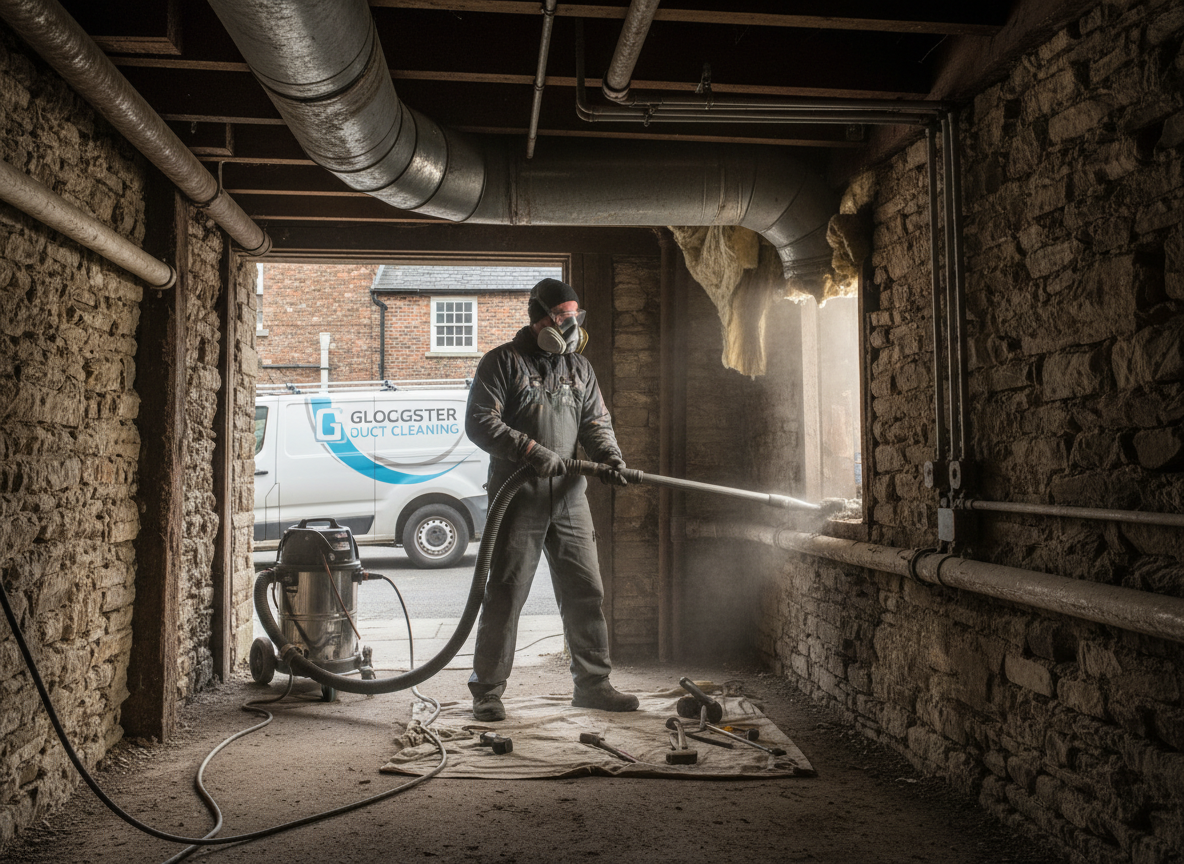
Gloucester City features many pre-war row homes and brick structures with narrow basements and limited attic access. These conditions make full duct cleaning more involved than in newer subdivisions because technicians must often work through small crawl spaces or remove registers one at a time to reach trunk lines without disturbing plaster walls or original flooring. River humidity from the nearby Delaware adds moisture that binds dust and lint inside metal ducts, requiring longer vacuum cycles and more frequent filter checks during the job.
When ducts run through unconditioned spaces common along Johnson Boulevard and the waterfront blocks, temperature swings cause condensation that traps allergens and fine particles. A standard residential system here can hold years of accumulated debris that restricts airflow and forces HVAC equipment to work harder. Professional cleaning uses negative-air machines connected at the furnace to pull contaminants out through the entire network rather than pushing them room to room.
Older galvanized ducts in Gloucester sometimes show corrosion at joints or have been modified over decades with flexible runs that trap debris. Technicians inspect every accessible section first, then use rotary brushes sized to each duct diameter followed by HEPA filtration to capture loosened material. Homeowners are advised to replace or clean furnace filters immediately after service because dislodged particles can reach the blower if the filter is neglected.
Access Challenges in Gloucester Housing
Pre-1960 homes along the river often have ducts routed behind finished walls or under low porches, requiring extra time to locate and open every register. Skipping any section leaves behind the very material homeowners called to remove.
Technician insight
In Gloucester, the thing that catches most people out with professional duct cleaning is the tight crawl spaces under pre-war row homes near the Delaware where river humidity packs dust into corners that standard shop-vac methods never reach.
Row Home on N Johnson Blvd
Homeowner reported weak airflow from ceiling registers. Inspection showed compacted debris in the main trunk running under the first-floor joists. Crew used narrow rotary tools to reach the restricted sections without opening finished ceilings. After extraction, measured airflow returned to normal levels.
How it works
- 1
Initial Inspection
Technician examines all accessible ducts, registers, and the furnace or air handler to map the system layout and note any damaged sections before starting.
- 2
System Isolation
Furniture and flooring are protected and the HVAC system is isolated so negative pressure can be applied without affecting living spaces.
- 3
Mechanical Cleaning
Rotary brushes and compressed air tools agitate debris while a HEPA vacuum draws material out through the main trunk lines.
- 4
Final Verification
Each register is checked for remaining debris and airflow is tested before the system is returned to normal operation.
Pricing
Pricing depends on number of runs, access difficulty, and overall system condition. Upfront quotes given after inspection.