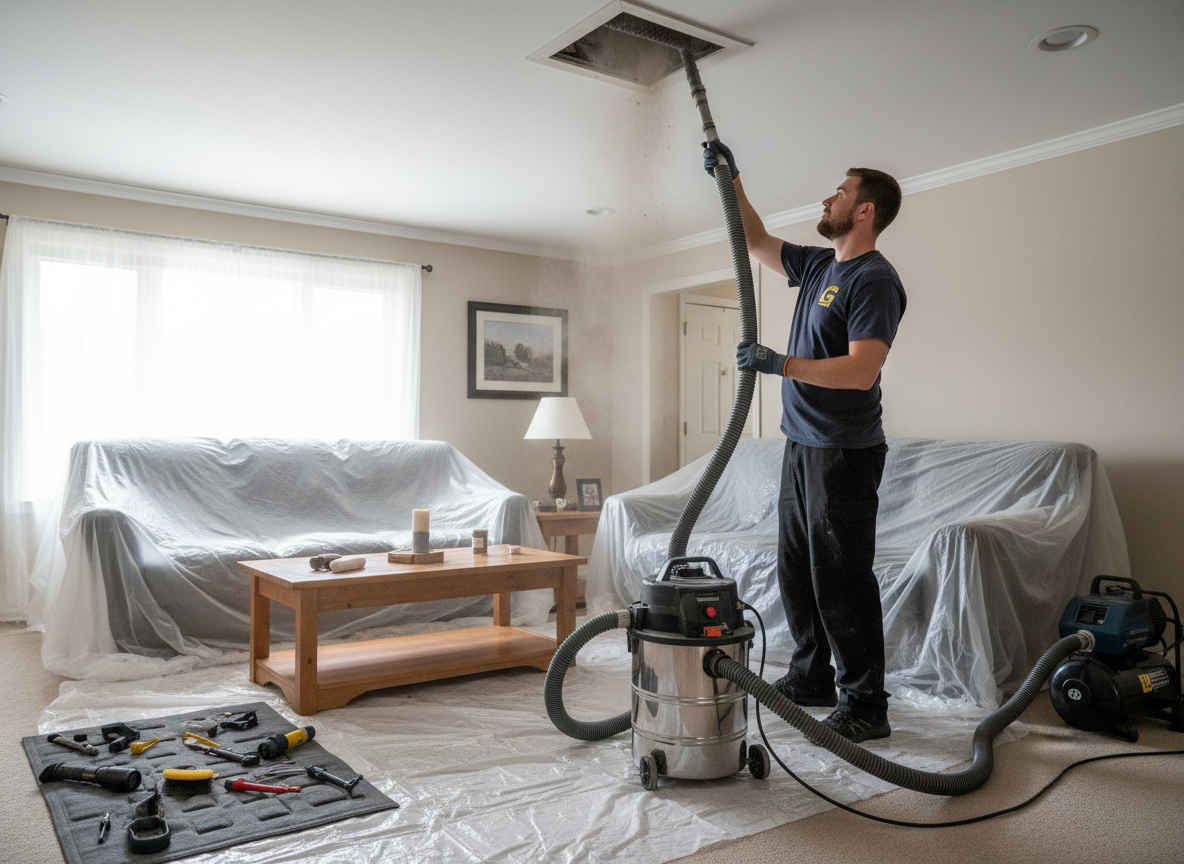
Gloucester City housing stock includes many older single-family homes and row houses built before 1970 that often feature narrow, multi-bend duct runs and original metal registers. These systems collect fine construction dust, insulation fibers, and river humidity-driven condensation that promotes mold on interior surfaces. Cleaning requires removing each register, using brushes sized to the 4- to 6-inch branch lines common here, and negative-air machines placed at the exterior to avoid blowing debris into living spaces.
Summer humidity from the Delaware River and winter heating cycles create alternating moisture and dryness that loosens debris in the main trunk lines. Homeowners frequently notice musty odors or uneven airflow in upstairs bedrooms after the first cold snap. Our process includes camera inspection of both supply and return sides before and after work, plus vacuuming of the furnace blower compartment to prevent re-contamination during the next heating season.
Pet owners in neighborhoods near Johnson Boulevard and along the waterfront report heavier dander accumulation because many homes have central returns located in hallways rather than dedicated closets. We isolate each zone during cleaning to keep pet hair from migrating into already-cleaned sections. Access panels are cut only when existing openings prove insufficient, then sealed with code-compliant screws and mastic.
After service we recommend replacing or cleaning the furnace filter within 30 days so the newly cleared ducts do not pull fresh debris back through the system. Gloucester City residents with oil or gas furnaces also receive a quick visual check of the heat exchanger area for soot that can indicate combustion issues unrelated to the ducts themselves.
Technician insight
In Gloucester the thing that catches most people out with Residential Air Duct Cleaning is the age of the ductwork in homes near the river. Narrow 1950s-era branch lines trap moisture from summer humidity and then bake it into a fine dust layer during winter; if you skip the blower compartment the first heating cycle just pushes that material right back into the rooms.
Row Home Near Johnson Boulevard
A Gloucester City row home showed reduced airflow in second-floor bedrooms after the furnace was replaced. Camera inspection revealed heavy lint and pet hair compacted in the original 4-inch return runs. We removed the registers, agitated and extracted the lines, and vacuumed the new blower housing. Airflow returned to normal and the musty odor disappeared.
How it works
- 1
Initial Walk-Through and Camera Inspection
We arrive at the Gloucester City address, review access points, and run a camera through the main trunk and branch lines to document current condition.
- 2
Register and Boot Removal
Each supply and return register is removed, cleaned separately, and set aside while the duct openings are sealed for negative pressure.
- 3
Agitation and Vacuum Extraction
Rotating brushes and compressed-air whips loosen debris while a HEPA vacuum at the exterior pulls material out of the system.
- 4
Blower Compartment and Final Check
The furnace or air-handler cabinet is vacuumed, registers are reinstalled, and a second camera pass confirms clearance before we restore normal operation.
Pricing
Cost depends on number of runs, stories, and whether the system has been neglected; we provide an on-site assessment before work begins.