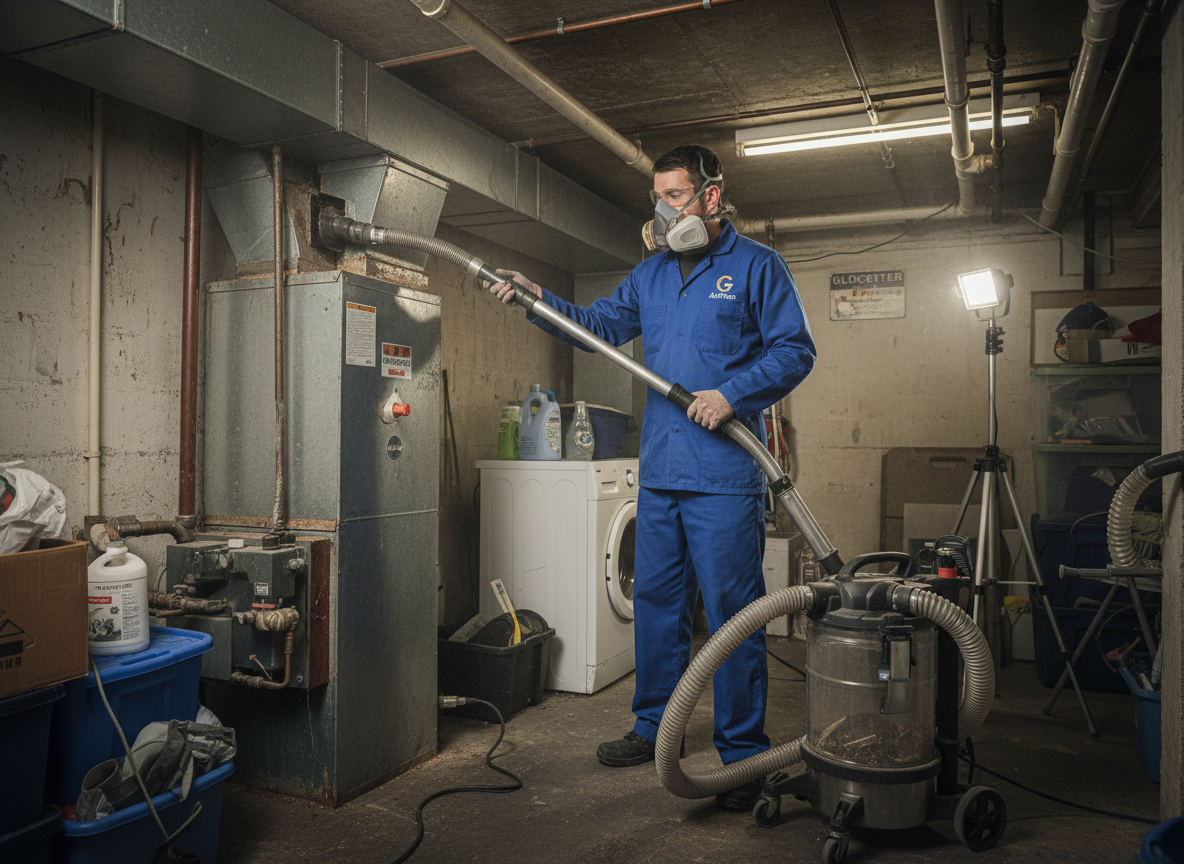
Gloucester City homes built before the 1970s often have rigid metal duct runs with multiple 90-degree elbows that trap lint and construction debris from decades of renovations. These systems sit low in crawl spaces or basements where Delaware River humidity keeps residue damp and heavy, requiring longer vacuum cycles and brush agitation than newer flexible-duct installations. Technicians at Uplift Pulse start every job by mapping the trunk and branch layout from the attic or basement access points before any equipment enters the home.
Seasonal temperature swings in Camden County pull warm, pollen-laden air through supply registers in spring and force heating-system dust back into living spaces during winter. Older plaster walls and original floor registers common along Johnson Boulevard and Klemm Avenue create narrow return paths that clog faster than modern sidewall returns. A full cleaning therefore includes removing each register, vacuuming the boot, and checking for gaps that allow unfiltered air to bypass the filter entirely.
We run negative-pressure equipment from the main trunk while feeding rotary brushes through every accessible branch, stopping at each elbow to confirm the line is clear before moving on. Homeowners in Gloucester frequently report reduced dust on furniture and fewer musty odors after this process, especially in two-story colonials where the second-floor ducts run through unconditioned knee walls.
Final steps include replacing or cleaning the filter, sealing any visible gaps with mastic, and showing the homeowner the material removed so they can see exactly what left the system. This inspection-based approach prevents unnecessary disassembly on homes where ducts run behind finished walls.
Technician insight
In Gloucester, the thing that catches most people out with Air Duct Cleaning near me is how often the original floor registers in pre-war homes sit directly above damp crawl spaces along the river, so the first two feet of every run are packed with wet lint that standard brushes slide over unless you stop and agitate by hand.
Second-Floor Ducts in Gloucester City Colonial
Homeowner noticed heavy dust on second-floor furniture despite frequent filter changes. Inspection showed the return trunk running through an unconditioned knee wall had collected years of insulation fibers. We isolated the section, ran extended brushes from the attic access, and pulled the material into the vacuum. Airflow at the upstairs registers increased noticeably once the line was clear.
How it works
- 1
Initial Walk-Through
Technician inspects every accessible register, return, and the furnace or air handler to map duct layout and note any damaged sections.
- 2
Negative-Pressure Setup
Equipment connects to the main trunk line to create suction while brushes and compressed air dislodge debris from branch runs.
- 3
Register and Boot Cleaning
Each floor register is removed, the boot is vacuumed, and the register itself is cleaned before reinstallation.
- 4
System Verification
Technician checks airflow at multiple points and confirms no new gaps were created during cleaning.
Pricing
Pricing depends on number of runs, access difficulty, and system condition; we provide an upfront quote after the walk-through.